The Devils: A Censored History
With Ken Russell’s 1971 film The Devils finally getting the much-anticipated Director’s Cut released to cinemas and home formats, film buffs are finally seeing something closer to Russell’s vision. Conor McVarnock reviews.
With Ken Russell’s 1971 film The Devils finally getting the much-anticipated Director’s Cut released to cinemas and home formats, film buffs are finally seeing something closer to Russell’s vision. Conor McVarnock reviews.
2026 will be long remembered in film history not just for the great new cinema released this year but, importantly, for a film that has not been available to see on the big screen in its intended form for decades. We now have what might be the most important release of the year, a beautifully restored full director's cut of The Devils.
Ken Russell was one of the most unique voices in British cinema in the last century. British post-WW2 film culture is associated mainly with two things: the tales of the mannered affairs of the ruling class – the whole Merchant Ivory thing, and the terse social realism born from the “Kitchen Sink” stage dramatic tradition of the likes of Ken Loach and Mike Leigh. Russell was as far away from all that.
A child of the 1960s counter-culture, his films were psychedelic, sexual fever dreams. The art medium that most often inspired his work was not the theatre or literature but music. He started making biopics of the great composers for the BBC, including feature films about Liszt and Mahler.
His best-known film is the rock opera Tommy, which he made with The Who. Formally radical in the sense that they spoke the visual language of maximalist extreme cinema, his films were loaded with philosophical discourse but never overtly political.
Except for this one.
The Tale
The Devils was Russell’s 4th feature film. It is fundamentally about the intersection of politics, religion and sex. It still has a lot of real bite and is an example of how truly great, revolutionary cinema can become relevant over and over again as each generation makes its own struggle.
It is an adaptation of the book The Devils of Loudun by Aldous Huxley, a work of non-fiction that combines the history of real events in the French town of Loudun in the early 17th century with discussions of the philosophical ramifications of those events as they pertain to the psychology of mass hysteria.
It is the true story of the supposed possession by Devils of a community of Ursuline nuns. This eventually led to the trial of the local priest and acting leader of the town, Urban Grandier, who, in the course of the public exorcisms of the nuns, is accused of being a sorcerer.
However, this is not some Hammer House of Horror film. Although it contains much which is horrific, there are no actual Devils, nothing of the supernatural. The main concern of both the book and Russell’s film is how religious fervour can be used for political ends.
The “real story” is a microcosm of what Marxists understand as the crisis of feudalism, as that mode of production came into conflict with the nascent bourgeois revolution as actualised through the Protestant Reformation.
It is the early 1630s, and the Thirty Years' War is still raging in the Holy Roman Empire between Catholic principalities and various brands of Protestantism. The Eighty Years' War of resistance of the Dutch against the Catholic Habsburgs is still ongoing.
Most importantly for this story, the French state has violently crushed the Huguenot uprising, and Cardinal Richelieu is looking to consolidate the central authority of the King over the regions. One part of this is tearing down the old city wall defences of any town or city in the kingdom.
In the town of Loudun, though, this would prove more difficult than anticipated. In spite of a large Protestant population, it had stayed out of the Huguenot uprising and valued its regional independence. In any event, the recently deceased governor had been promised by Louis XIII that it would be left alone in thanks for its loyalty.
So when the army shows up to dismantle the walls, it is met with resistance, led by Urban Grandier, who has become the real ruler of the town. Popular, intelligent, and charismatic, he has become a problem for the state that will prove difficult to crack.
The opportunity to deal with him, however, presents itself.
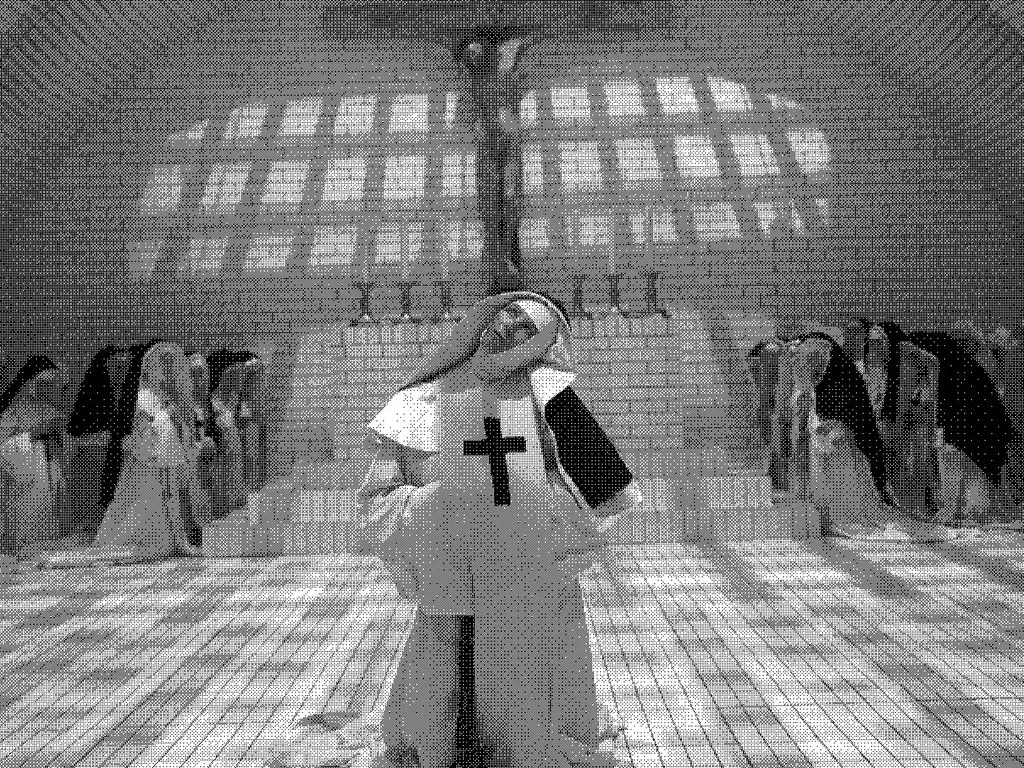
Aside from everything else, Grandier is a known womaniser. There is an outbreak of religious hysteria caused by the supposed demonic possession at the local Ursuline nunnery. This is led by Sister Jean of the Angels, who had a personal sexual fixation on Grandier. The exorcists and witch-hunters are then called in, and it's not long before Grandier is labelled a sorcerer, personally responsible for corrupting the nuns via a demonic pact.
The Film
Russell’s film, which stars Oliver Reed as Grandier and Vanessa Redgrave as Soeur Jean, follows this story with remarkably little poetic license. Much of the most violent and phantasmagorical sequences are based squarely on actual events as outlined in the book, which are taken from contemporary accounts and subsequent secondary literature.
In spite of, or perhaps because of this, it has been one of the most censored films in recent history. Only released in a heavily cut form in the UK on initial release and an even further cut version in America, it was long missing one particular sequence where an orgiastic excess of politically inspired corruption of religion is juxtaposed with the simple sincere faith of Grandier as he takes communion in nature.
It’s this sequence which Russell, himself a deeply spiritual man and committed Catholic, considered the thematic heart of the film.
The decades-long road to a full director's cut started in the 1990s with a conversation between Russell and the film critic Mark Kermode, who, after expressing his admiration for the film, was informed that he hadn’t really seen it. In Russell's words, he would spend years hunting down a print of the excised material, and then, after it turned up, further years trying to convince Warner Bros who held the rights to the film, to release the full cut.
Kermode has written, “This film from the 1970s about the 1630s, this parable about corrupt authority, an authoritarian leader, using religious hysteria for their own personal and political enrichment has become astonishingly relevant to a modern audience”
Rumour has it that one executive hated the film, found it offensive to the point that as long as he was around, it would never see the light of day. If this is true, then that individual must have either died or retired within the last 18 months, since the launch of Warner's Clockwork, a new boutique imprint set up by Warners to fund and distribute the types of projects that the likes of Neon and A24 Pictures have had success with. The Devils is their flagship project and first major release.
First shown at Cannes where it became one of the big events of the festival, it's now showing in cinemas worldwide since the end of October, presumably ahead of a release on streaming.
For many filmgoers who may be fans of Russell's other work and have been aware of the rights issues over such a long time, this is the film event of the year, if not the decade. The new cut has also come with a full restoration, which makes the colours of the already striking visuals look incredible. That said, this isn’t going to be for everyone, and some people are going to struggle with the extreme violence and sexual content.
The juxtaposition between those elements of the film and the blackly comedic tone that pervades much of the film not sitting well with everyone. If you have religious trauma, it’s going to be either triggering or profoundly cathartic. I do think it is an important work of art that is as relevant now as it ever was. In the book, Huxley explicitly draws a straight line between the hysteria and witch-hunting of the 17th century with the Moscow show trials, and then recent events in Europe under fascism.
It’s hard not to see it now without thinking about the current hysteria against migrants and the trans community being whipped up by the far right here or Qanon and the MAGA movement in general in the USA. On that basis, worth checking out, in a cinema if possible, if you think you can hack it.