
Feminisation of the Working Class: New Militancy?
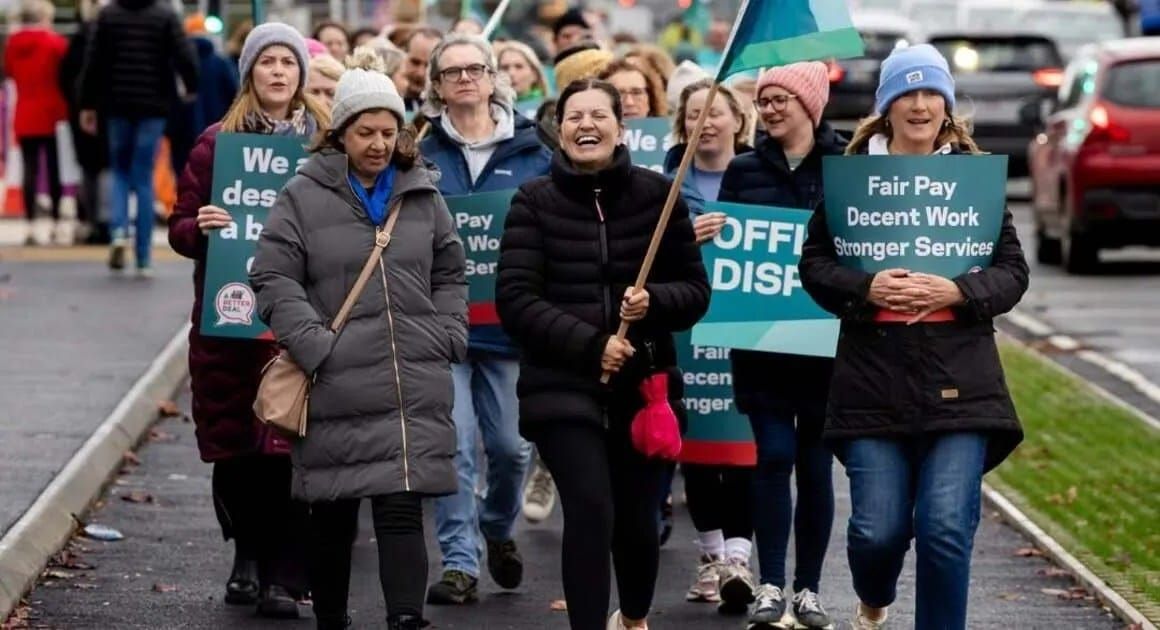
When 300,000 public sector workers went out on strike, the majority were women. The picket lines were living proof of how much our workforce has become feminised.
The increase in the number of women in paid work here is relatively recent, and quite dramatic. According to the latest CSO figures, there were over 1.3 million women in employment in the second quarter of 2026, up massively – almost 90% – since 2000.
Women now account for a large majority of workers in sectors such as Human Health & Social Work and Education. Correspondingly, the number of women who report their principal Economic Status as “engaged in home duties” has decreased considerably.
Female labour force participation in Ireland now stands at 71%, (men’s is at 78.8%). This is more than double what it was in the 1980s and is now closer in line with what exists across the EU.
Of course, sectors like Big Tech, are still notoriously gender discriminatory. Female employees make up between 29% (Microsoft) and 45% (Amazon) and women take up fewer than 1 in 4 technical roles in each of the companies reporting such a figure (and Amazon does not).
Amid the rise of women in paid work, their type of employment also tells its own story. Part-time work is very common amongst women.
In 2025, females in Ireland accounted for over 67% of people in part-time employment. Women are also seven times more likely to be on temporary contracts than men.
Childcare – the faultline
In Ireland, childcare services are very expensive. Minister Jack Chambers had the gall to announce that next year he would be reducing the maximum childcare fees paid by parents, from €735 to €550 per month, for children up to senior infants.
Of course, this ignores that real childcare costs are much more than this – anywhere between €1,200 and €1,500 a month.
Childcare in Ireland, according to the OECD, is one of the most expensive in the developed world, representing on average a massive 23% of family income.
Ireland simply does not have a public childcare model. Three quarters of Ireland’s creches, playgroups, Montessori, Naíonraí and childminders operate as private businesses, some of which are struggling to stay open.
Subsidies for parents, from the National Childcare Scheme – €2.14 per hour up to 45 hours per week, and a means-tested offering of a bit more – are way too little to really compensate.
Ireland probably has one of the poorest records for supporting women and children. In the North, there are around 222,000 people providing some form of unpaid care, as reported in the 2021 Census.
This represents around 12% of the total population and has increased substantially in recent times. Unpaid care saves the Northern Ireland Executive approximately £5.8 billion in costs each year.
In the South, carers provide 19 million hours of unpaid care every week, saving the State approximately €20 billion annually.
Women continue to do twice as much unpaid care work as men. The National Women’s Council spells out what this “Care Gap” means.
In two-parent families, women are more likely to take unpaid time off or move into part-time employment to care for children. This has long-term implications for women’s education, careers, and pensions. 80% of single parents are women, and this socially unrecognised care is provided by other family members, often grandparents.
Furthermore, women of all ages are also the main carers for sick or elderly adults. In Ireland, 98% of all full-time carers are women.
It is migrant women who bear the full brunt of low-paid work. They make up a vital part of Ireland’s frontline health and social care workforce. For example, over half of practising nurses in Ireland are trained abroad – in India, the UK, and the Philippines.
These workers frequently face systemic discrimination, workplace bullying, and so-called ‘client-preference’ hurdles – i.e racism.
Low-paid care work by migrant women is the hidden infrastructure of capitalist economies. It is they – alongside the legion of other women carers at home – who keep people healthy and looked after.
They ensure that tomorrow’s workforce is provided for and that yesterday’s workers are looked after – at minimal cost to employers and the state.
Feminisation of struggles
Women have become major participants in the organised labour movement. A 2021 UCD report showed the growth in female participation in the labour market is matched by growing numbers of women joining trade unions. In Ireland, there are now more women than men in trade unions.
And we have seen more strikes led by women. From the Debenhams long strike during Covid, to the current ongoing Northside Home Care Services strike action in Dublin, precarity and low pay have triggered determined fightbacks.
In both these cases, the workers came up against the meek trade union bureaucracy – Mandate in the case of Debenhams and SIPTU in the Northside Home Care Services – whose reluctance to take on the employer forced the women to lead their own fight back and strategize for themselves. These women were not stuck in old social partnership routines and developed their own strong and militant methods of organising.
Northern Ireland health and social care staff had a week of industrial action in 2023 over low pay and conditions with Unite and Unison picket lines being largely made up of women. UCU lecturers struck for better pay in the same year.
It remains to be seen whether the public sector strikers in the South can build on the strong lead of the first day of strike on 14 October, stick it out against any ICTU compromise and win a decent pay increase.
Political strikes
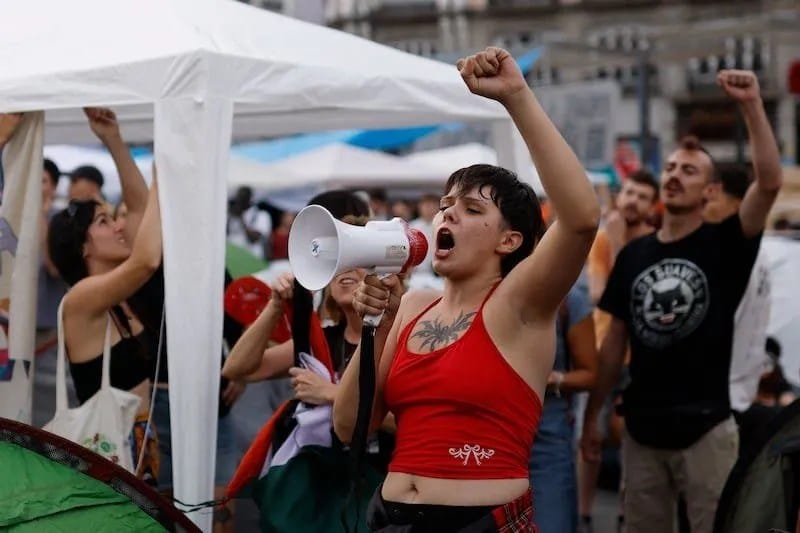
It has also been the case that women have been in the forefront of political strikes and protests. The Dunnes Strike in the 1980s over South African apartheid showed the power of women workers in taking on broader political and social injustices.
We have also seen other female strikes that have moved beyond pay and conditions and taken up gender rights.
At the end of September, in India, hundreds of women staged walkouts from Delhi University campus calling for justice for the survivors of rape. These echoed the wave of feminist strikes a decade ago in Argentina, which brought the Ni Una Menos (‘not one woman less’) onto the streets in a massive wave of worker- and community- wide protests against gender- based violence.
Later in 2018, the feminist strike in Spain evolved into global mass actions protesting gender-based violence, femicide, gender discrimination.
Today’s student and school protests and strikes in France have also seen women and mothers on the front line. Female teenage students have emerged as prominent activists, protesting against the crumbling school infrastructure, teacher shortages, police repression, Macron and the far right.
‘Banlieu Mothers’ Groups’, sparked by a video of a mother dragging her son from a barricade in flames, have come together in the Parisian suburbs to stand with the students. Similarly, the Spanish housing movement, which has the evicted pensioner Maricarmen Abscal as its symbol, has seen women as central to the protests against soaring rents and gentrification.
As both French and Spanish movements plan general strike days with the unions for early November, we are seeing the return of the political strike and women playing a key part. The years of neoliberal austerity with a deep crisis of housing and cost of living, alongside many more women in low paid work, have projected women to the fore as key activists and organisers.
Gender stereotypes challenged
Women entering paid work in larger numbers has also disrupted older traditional models of the family – however much the far right wish it to be otherwise.
With many more women in paid work, new ways of living, new combinations of people within households, and different types of homes have evolved. There has been a significant shift in household composition and a gradual replacement of the male-headed nuclear family by a diverse range of household compositions and forms as women, as paid workers, have an independent source of income.
In Ireland nearly a quarter of households are now one-person households, one tenth one parent families, and nearly as many homes are made up of unrelated adults sharing living spaces. Add to this the increase in intergenerational households with adult children in paid employment in them as they cannot afford their own place, and the old- style nuclear family model no longer fits.
Many of these changes have been reflected in movements like Repeal even if we still have a long way to go. Nevertheless, much larger numbers of women in paid work, alongside social movements on the ground, have combined to inject strength into the battles against the many barriers of gender discrimination.
We are living through deep social crises created by the ever more powerful forces of capital. The most oppressed and “down-trodden” layers of the working class, as Trotsky once noted, can become the most revolutionary and militant during such periods of social upheaval.
There are signs that this may be the case amongst the growing female ranks of the working class today.