French protests, widening politicisation and anti-fascism
The struggle in France shows that the radical left are re-emerging and able to fight back against the fascists. Catherine Curran Vigier writes about how the left are getting behind Mélenchon, even if there are limits to his programme.
The struggle in France shows that the radical left are re-emerging and able to fight back against the fascists. Catherine Curran Vigier writes about how the left are getting behind Mélenchon, even if there are limits to his programme.
Two months into a movement characterized by phenomenal levels of police repression, university and school students are fighting on.
Faced with such stubborn resistance, and the huge success of the one-day strike on November 5th, Macron called in union leaders, his ‘social partners’, for negotiations on Monday, November 9th.
They were offered crumbs – a €5 increase on the minimum wage, a government pledge to encourage bosses to think about increasing the lowest wages and these points to be worked towards in the next round of annual wage negotiations inside companies.
The biggest union, the CFDT, and two others, FO and the CFTC – accepted the rotten deal. The bosses are standing firm, and refusing to hand over even the crumbs the government put on the table. The more combative unions, the CGT and Solidaires, have called another day of strike for Tuesday 17th November.
Students defiant
As the ‘social partners’ were going along with the government’s charade on Monday, thousands of students were holding general assemblies across France and resolving to continue the struggle.
Students and the Yellow Vests called for demonstrations on Saturday 14th November and on Saturdays thereafter. Macron has tried to ensure that only demonstrations called by trade unions will be authorized. He has co-opted the unions to help him police his demonstrations, thus creating opposition between students and the unions.
Nevertheless, students have continued demonstrating. In places like Toulouse where demonstrations were banned people have defied the police and the interior minister Nunez. And even on the authorized routes, police have used massive amounts of tear gas on demonstrators.
Some sectors outside education have announced they will be striking alongside teachers and university lecturers next Tuesday – like dockers from the ports of Le Havre and Rouen and gas company workers in the south of France.
So far, Macron and his government have refused to give any meaningful answers to any of the students’ key demands – 125,000 more places in universities, investment in the renovation of schools and universities, more and better-paid teachers, smaller classes, an end to selection for university places.
The bosses are holding firm behind Macron, as are the fascist Rassemblement National (RN). They have backed Macron’s economic program since the last general election of 2024.
Political gains and anti-fascism
Thus far, the movement has made no progress on its economic demands. The political gains, however, have been enormous.
The growth of the youth movement has fed into a fightback on the question of racism. After the hugely successful mobilisation against RN’s conference in Orléans on October 24th, images of the Union of Jewish Students of France (UEJF) students being expelled with bloodied faces were seen everywhere on social media. This showed the real face of the RN.
Journalists finally began questioning RN President, Jordan Bardella, on his youthful antisemitic writings. When Bardella expelled left-wing online journal Mediapart from his book launch, practically all the other journalists left in solidarity. This is new.
Over one million people signed a petition for the removal from public television of the racist TV channel, CNews, financed by the fascist millionaire Vincent Bolloré. The government shelved the petition, but the anger remains.
Journalists striking over Bolloré’s predatory acquisitions in the media largely went unnoticed in the past. Now people are questioning the role of major news networks like his in promoting racism.
This comes in the wake of last month’s murder of 26-year-old Pengo Bossio Wangi in Trappes by an admirer of Le Pen’s RN.
The public is not alone in challenging the role of far-right media in inciting racist shootings. A hundred and twenty technical staff at BFM TV went on strike and four hundred signed a letter to management protesting against presenter Sonia Mabrouk, who had been recruited from CNews. Mabrouk has been notoriously on side with far-right interviewees and their racism.
This wave of antiracism is putting the RN on the defensive. The party is now forced to submit to closer questioning about its economic and social policies. These are as neoliberal as those of Macron.
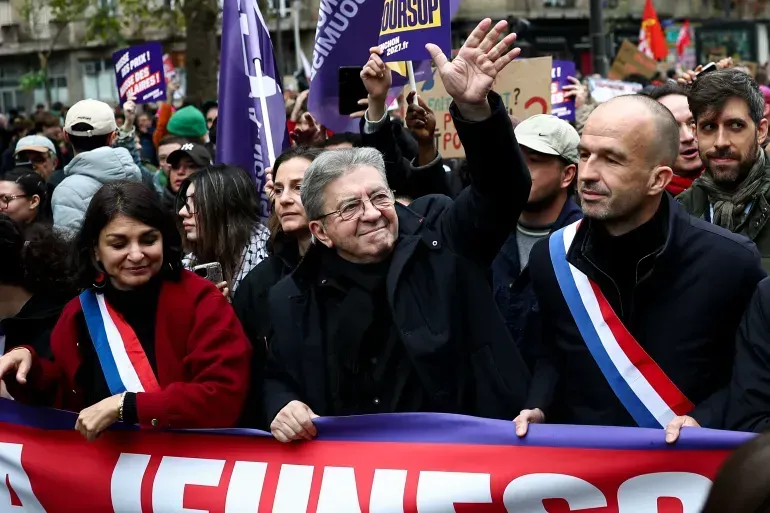
The fightback against racism was led by the student movement, by the big demonstration at the RN’s conference, and by the presence in the movement of La France Insoumise (LFI) deputies like Bally Bagayoko, Nadège Abomangoli, Danièle Obono, and others. When Bagayoko defended school students against the police in St Denis, where he is the mayor, and the image went viral, it gave a boost to all those who were fighting racism in France.
He has been the object of ferocious racist attacks and death threats.
La France Insoumise
Of all the political parties on the left, LFI is practically the only one to have been on the blockades outside schools with the pupils. It has denounced police violence, although Mélenchon has called on his supporters to avoid violent actions and has distanced himself from the rioters.
LFI is clearly on the side of the movement. The socialist party (PS) candidate Raphael Glucksmann was met with hostility when he joined the Parisian demonstration on November 5th, and he had to leave. This was mostly on account of his being seen as another Macron.
LFI’s identification with the movement has contributed to the immense popularity of Mélenchon’s Presidential election campaign, with thousands of young people attending his rally at Le Bourget. His programme A Shared Future, (L’Avenir en Commun) is online but has also sold out in bookshops.
Left critics say it is just rehashed social democratic demands, even falling short of what Mitterrand proposed in 1981. However limited it is, the programme manages to relate to people’s lives – promising to freeze gas and electricity prices, renationalize the motorways; lower the price of petrol to 1.70 a litre and bring water resources under public control.
It proposes measures to deal with environmental issues like factory farming, use of pesticides in agriculture, and global warming, as well as poverty, healthcare and education. For example, it proposes free school dinners for all primary school children, in a way that puts the cost of living at the heart of political debate right now.
Keynesian measures to relaunch the economy by boosting consumer spending are not going to solve capitalism’s long-term problems. Any government trying to implement them will face ferocious resistance from the capitalist class. But getting them implemented would be a defeat for those same capitalists.
Europe is on the move. Ireland needs a left that is too.
Join the Socialist Workers NetworkA focal point and hope
Mélenchon’s program is a focal point for left unity, and that is crucial if we want to stop Marine Le Pen becoming President and her party gaining a majority of seats in parliament. It gives people a reason to hope, especially the young people who are driving this movement.
This hope is behind Mélenchon’s rise in the opinion polls. The latest Politico/Cluster 17 poll on 9-10 November put him at 21% and Le Pen at 30.5% for the first round of the elections which will take place in April 2027. With a plethora of candidates on the right including European Central Bank director, Christine Lagarde, there is no shortage of neoliberals peddling austerity politics.
If Mélenchon gets 20% or more in the first round, he is likely to get to the second round. Polls currently place him second behind Le Pen.
Beating Le Pen in the second round will take something more, since most of the right will vote for her. But the mobilisations have stopped an increase in her vote among young people – Mélenchon has the support of 44% -47% of 18–34-year-olds.
He is also winning many on the left to his campaign.
In an interview on left-wing news station Le Media on YouTube after the riots on October 17th, Sandrine Rousseau, a leading figure on the left of the Green Party (EELV), said it was urgent for the rest of the Left to defend LFI from the attacks of the right and far right, and to get behind the left candidate with the best chance of winning the Presidential election - Jean-Luc Mélenchon.
She said that this was “the final battle” – and that the outcome would be either a totally unbridled capitalism, like Trump’s America, or a completely different kind of society. She urged every group on the left to get involved in the fight alongside LFI.
The right wing of the Greens has already thrown in its lot with Raphael Glucksmann. The Green party leader, Marine Tondelier, who wanted to stand in the Presidential election, now finds herself at 1% in the polls with neither left nor right of her own party behind her.
Similarly, nine out of seventeen PCF-affiliated deputies have pledged to support Mélenchon, to the outrage of Fabien Roussel, the party leader who fully intends to maintain his own candidature.
The group of former LFI deputies around Alexis Corbière and Clémentine Autain who left some time back are now talking about returning to the fold.
Uniting against fascism
The anticapitalist wing of the old NPA behind Olivier Besancenot and Philippe Poutou have also come out in support of Mélenchon.
There is a dynamic for unity on the left behind the leader of LFI.
A victory for Mélenchon in the Presidential election would stop the fascists getting hold of the levers of state power. This is crucial. Revolutionary groups like Lutte Ouvrière who say that Mélenchon’s programme is simply creating illusions and leading the working class down a blind alley are themselves blind to the clear and present danger of a fascist party coming to power – something which would set us back for years.
Le Pen is not Meloni. Her party was founded by former members of the Waffen SS and her father, Jean-Marie Le Pen, was involved in torturing prisoners during France’s colonial war against Algerian Independence. The Presidential function in France goes with enormous powers, and the party of the president-elect often (although not always) gets a majority in the general elections that follow.
Le Pen and her party will be out for revenge, and the Nazi thugs who attacked demonstrators on October 24 in a dozen French towns will be back in force. This movement gives us the means to stop her, on the streets and at the ballot box. What matters now is getting students and workers to join forces in a concerted bid to break the bosses’ lockout.
We need to break through the bosses’ wall of resistance to our demands, to give people the confidence to stop Le Pen in the months to come.
Catherine Curran Vigier is a socialist activist in Rouen