Why the public sector pay deal is not good enough
Union leaders pulled the plug on public sector rallies that were to coincide with the arrival of EU leaders. Kieran Allen looks at a proposed public sector deal and argues that it falls well short of what workers need.
Union leaders pulled the plug on public sector rallies that were to coincide with the arrival of EU leaders. Kieran Allen looks at a proposed public sector deal and argues that it falls well short of what workers need.
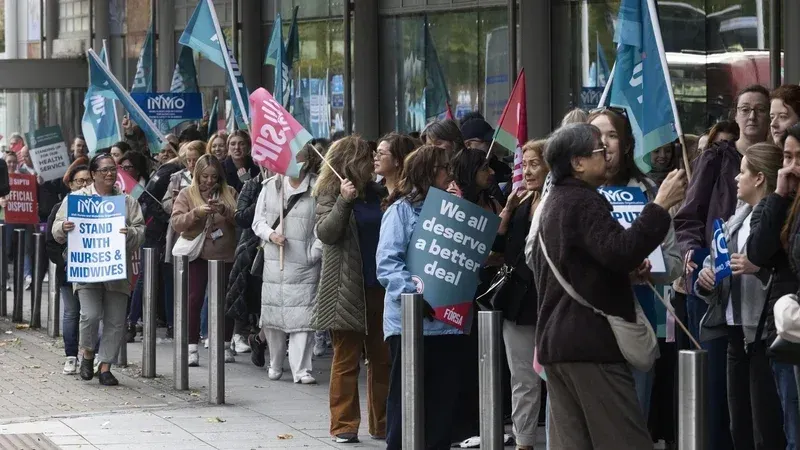
On Wednesday, October 14th, the unions came to life. Everywhere you looked, there were big picket lines outside offices, colleges, and hospitals. The atmosphere was joyous. Workers felt they had the power to force a right-wing government to give them a fair wage. Scores of new members were joining unions.
Rachel, a SIPTU activist, explained,
‘You could see the enthusiasm for action. In my job, about 50 people joined the union. They saw us doing something and wanted to be part of it’.
Fianna Fáil and Fine Gael ministers regularly boast about a huge government surplus. They rarely acknowledge that it comes from Ireland’s role as a tax haven for US multinationals. But they insist there is no money to pay their own employees a decent wage. In his budget speech, Jack Chambers allocated only €1.2 billion for public sector pay rises.
The strike on October 14th shook the government out of their complacency. They were embarrassed by the possibility of further action when EU Ministers came to Dublin on 12 November. So, they scrambled to make a deal with union leaders. The problem is that they got away with it too lightly.
Pay
Deirdre, an INTO activist, explains why,
‘In my district, there was an online meeting for over a hundred schools and we were preparing for a big shutdown and rallies on November 12th. Unfortunately, there was no discussion about what we were fighting for or our strategy to achieve it.
‘Then we got an announcement that the whole thing had been called off. But what happened to our original demands? The union leaders had rightly said that our pay had fallen behind the cost of living from 2021 to 2026. They even put a figure on it: we had lost out by between 5% and 7%.
‘We were looking for a pay rise that compensated for past losses and matched inflation. This is where the figure of 10% came from, and many thought it should apply to one year – not three.
‘But we are not getting anywhere near this. There is a 2% rise which is backdated for this year. ‘Frontloading’ as it is called, is designed to sweeten the deal in the run-up to Christmas and get people to vote Yes. Then there are drip-fed increases of 1%, 1% and 1.5% next year. These will not even match inflation’.
John is a SIPTU activist in the Office of Public Works.
‘In the run-up to our campaign, there was a shift in my workforce. We all thought that a 10% pay rise was what workers needed. I am not saying that people were energized, but there was a change: the question became whether we were going on strike – and most were in favour of it’
‘But now we face a proposed deal which does not compensate workers for high rents or basics such as food and heating.
‘Beforehand, SIPTU said that we should not be forced to use AI, but this is exactly what could now happen. There are several clauses in this proposed deal which will force us to use AI, even though it will bring huge environmental costs and lead to redundancies.’
Union Density
Why then did the union leaders call off the action?
Here you need to look at Irish trade unions in recent decades. Union density has declined significantly and, though it was almost unheard of in the past, some workers are refusing to join a union, in schools and hospitals. Only about one quarter of the Irish workforce is in unions.
The decline has meant that the government and employers sometimes get overconfident. They treat union leaders in a cavalier fashion, especially when it comes to local bargaining.
The union leaders felt they had to halt the decline in membership by calling action – and to some extent this worked. But they are also addicted to social partnership, to being on the inside track with government officials. They enjoy the ‘back channels’ where quiet phone calls are made between trade union officials and top department secretaries to do deals.
So, the union leaders wanted a show of strength, but they did not want to push it too far. The government also wants the union officials to slip back into the role that C. Wright Mills once called “managers of discontent”.
Take Croke Park hours, for example, which were first introduced after the 2008 economic crash. They specify that public sector workers must work for free for a defined number of hours each year. A school principal can invoke this agreement to insist that teachers attend extra meetings after school hours. Union officials will say they are opposed to this practice but argue nothing can be done about it because ‘we are tied to it by agreement.’
Productivity
Or look at the continual pressure for more productivity. ‘Sectoral agreements’ usually follow national agreements, and they involve negotiations at a local level to ensure that productivity clauses are implemented. Managers use the vague clauses in national deals to demand progress on implementing productivity before a pay rise is given. The proposed deal states boldly that ‘sectoral action plans’ must be first submitted to the relevant Department Secretaries, at least one month before even the miserly pay increases are agreed. Union officials are then put in a position where they have to give extra productivity themselves – they push workers into sectoral agreements to get pay rises.
One of the more insidious ways in which trade union officials are used to discipline workers is contained in clauses which play a divide-and-rule game. Take the case of ASTI and TUI members in schools.
If you were an ASTI member, you were sometimes excluded from pay rises because it was deemed that your union had not complied fully with agreements. By contrast, TUI was treated as the ‘good boys and girls’ because they were judged to have complied and so their members got a pay rise.
Imagine the effect. Someone from the Department of Education might ask you which union you are a member of, and depending on your answer, you either got or were refused a pay rise.
This new proposed deal states: ‘The benefits of the Agreement will be confined to those staff and employees represented by unions in membership of the Irish Congress of Trade Unions or other unions or representative associations which have notified the WRC of their intention to comply with the Agreement’.
Cynicism
It is no wonder that cynicism about unions comes easily to socialists. Many already know in advance that there will be a ‘sell-out’. And no doubt they are right about the motivation of union leaders.
But unions are the main vehicle by which workers organise collectively. They have big potential power, which was glimpsed on October 14th.
Moreover, the union leaders are not the only factor in any equation. They have to deal with a right-wing government and employers who have been emboldened by decades of neoliberalism. These employers and their state representatives are the real enemies. The problem with union leaders is often that they are too frightened to fight properly.
In recent years, the left has been weak in the unions. Members of parties like Sinn Féin or the Workers Party have been absorbed into the union bureaucracy and simply repeat the call for compliance, once top officials endorse deals.
If there are advances for the left in Ireland, this issue must be addressed. The left cannot just be about building in communities and not have a real base amongst organised workers.
Campaigning against the current proposals should be seen in this context. There are many workers whose sights were raised by October 14th and who want a better deal. The growing revolt in France is also showing a different and inspirational way of organising.
Instead of a No campaign issuing a leaflet and then disappearing for another few years, it is necessary to rebuild a strong left presence. We need to use WhatsApp groups, call workplace meetings and learn to discuss in a way that convinces workers to take action.
If we do that, we can help overturn this deal and re-ignite a fighting trade union movement.
Workers win when they organise.
Join the Socialist Workers Network and help build the fightback.
Join the Socialist Workers Network