France: Revolution 2.0
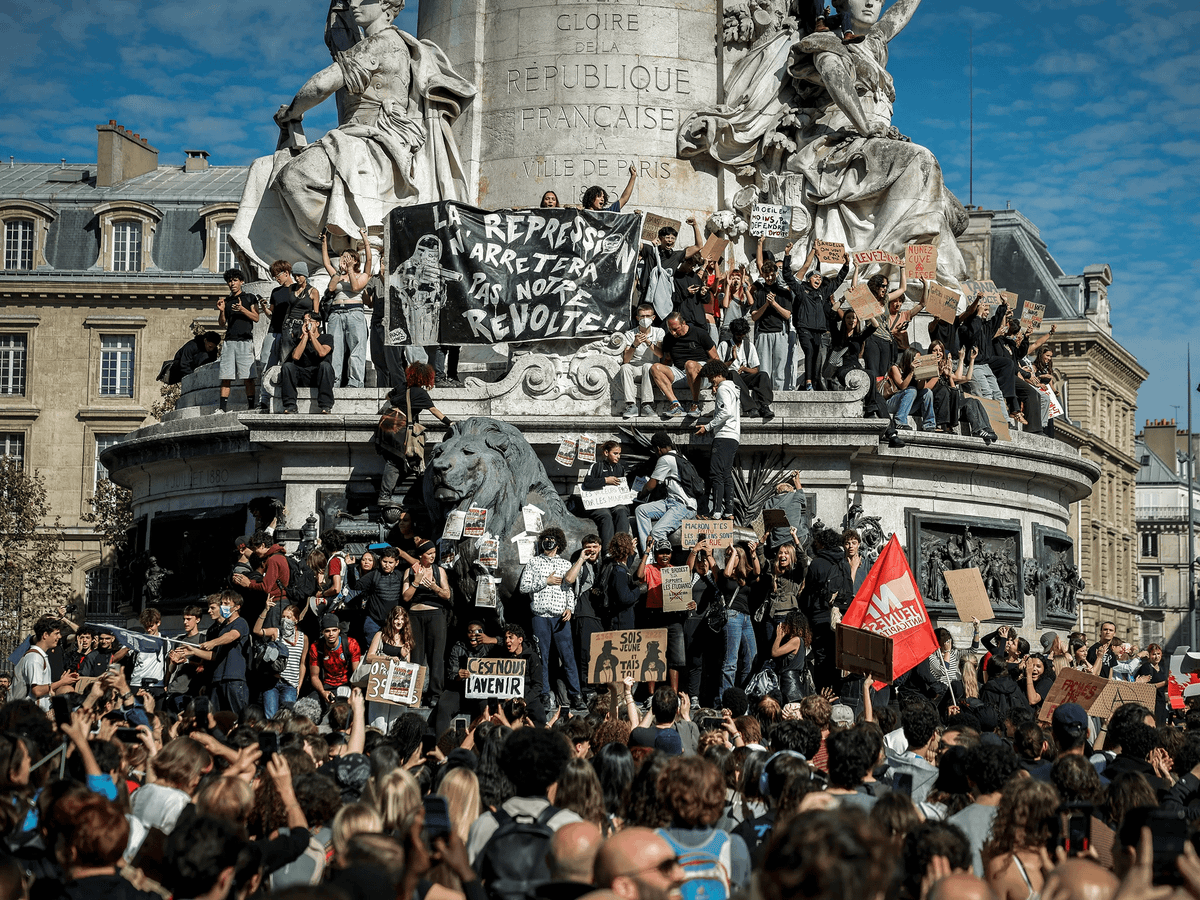
At the end of the giant student and worker demonstration in Paris on Thursday, October 8th, a banner was hung across the July Column in the Place de la Bastille. The banner read “Revolution 2.0, Rendez-vous October 17th”.
The banner reflects the sentiment of thousands of mostly young people demonstrating across France. After filling the place de la Bastille, one of the better-off areas of Paris usually packed with tourists and operagoers, students fought back against riot police. Late evening photographs showed young people pushing back police, who had to resort to water cannon as well as their usual teargas and baton charges.
Some demonstrators then went on an unauthorised demonstration to Place de la Nation.
On the evening news, the education minister Edouard Geffray announced that there would be 3,000 replacement teachers in the schools ‘within hours’. The announcement was met with derision. People asked where he’d been hiding them, and if the new recruits had even obtained their baccalaureate, and how much they would be paid.
The minister’s pathetic announcement, hedged about with qualifications like, “I really don’t know where I’ll get the money,” and “the software to manage all this has been slowing things down,” and “the state’s coffers are empty,” fell flat. Coming from a minister most people had never heard of before last week, from a government whose stock-in-trade is lies, media manipulation, and police brutality, it was barely credible. Besides, people wanted much, much more.
The announcement came at the end of an extraordinary day of mobilisation.
Blockades
Early morning reports showed France’s most right-wing university, Assas, a stronghold of the far right students’ union UNI, and GUD militia, blocked by hundreds of students. Some of the most prestigious private establishments, like the Institut Catholique de Paris, were blocked. The University of Nantes was occupied. Over 90% of universities were involved in the action. University Presidents, in panic and no doubt following government orders, locked out students and personnel in the hope that this would make the movement go away. It didn’t.
The movement which began as a demand for more teachers and adequate premises and equipment in the Parisian banlieue of Seine-St-Denis, France’s poorest département, has now become something far greater.
The biggest factor spreading the movement has been outrage at the police violence. In the past weeks, people have seen high school students tear-gassed, beaten, chased through the streets, arrested in thousands, and mutilated with what the police call “semi-lethal” weapons like stun grenades. On September 28th, in St Ouen l’Aumone, outside Paris, a fourteen-year-old had his jaw broken and teeth ripped out when a police officer aimed a Cougar teargas grenade launcher at him and fired at point-blank range.
On September 30th, in Tours, a sixteen-year-old lost an eye when a flashball was fired at him. The tipping point came on Monday, October 5th when a fifteen-year-old in Lens had his hand and forearm blown off after police threw a stun grenade into a group of demonstrating high-schoolers who were walking away from the blockade.
The following day, Tuesday October 6th, 450,000 demonstrators marched in cities, towns and villages across France, according to figures provided by the CGT trade union. This demonstration showed the solidarity that is another major factor driving the movement. Teachers and health workers answered their union’s call to come out and defend the school students, but the mobilisation was much wider than those sectors alone. Pupils in the wealthier Parisian schools came out alongside those from Seine St Denis, and the demand for equality of treatment for all in the education system was present everywhere.
Another major motivation is the issue of racial inequality. Anti-RN slogans are chanted everywhere, as well as “Siamo Tutti Antifascisti.” (We are all antifascists) The movement is as much a revolt against racism as a fightback against Macron’s austerity politics.
Union Bureaucrats
But despite the widespread presence of trade unionists in the demonstrations, the unions have been dragging their feet. Instead of calling everyone out on strike immediately in the face of the police violence, local and national bureaucrats have procrastinated and allowed the students to take the fight forward on their own. They have presented their involvement as ‘accompanying’ and ‘protecting’ the school students, while the students are demanding what the unions have been asking for since forever – more teachers, better working conditions, better pay for teachers, and so on.
There is a mood for strike action, as could be seen in the very effective strike at TotalEnergies, with up to 62% of the workforce blocking refineries in Normandy and Loire-Atlantique, and 50% out in La Mède near Marseilles, according to Révolution Permanente’s website.
Nevertheless, the joint union leadership or Intersyndicale showed their intention to keep things under control by calling for a day of action on November 5th – after the two-week Halloween break, when, they hope, the school students’ movement will have cooled down. However, they have been short-circuited by the students, who have called for a march on Matignon, the prime minister’s offices, on October 13th. There is also a call for a demonstration against the cost of living on October 17th, in a return of the Yellow Vests, which could well blow the lid off any attempt to contain the movement over the holidays.
La France Insoumise
Does the reticence of the union bureaucrats mean that the uprising is entirely spontaneous? Not quite. While the government’s wild accusation that La France Insoumise (LFI) is behind all this is just ridiculous, the party’s elected representatives, like Bally Bagayoko, mayor of St Denis, have played an important role.
Firstly, their presence outside schools has no doubt given confidence to the school students blocking their establishments. Secondly, LFI deputies have denounced the police violence and raised it in parliament. They have been able to contradict the government-imposed narrative of “urban violence” and confront the brutal Minister of the Interior, former Prefect of Police of Paris, Laurent Nunez, on his “no-holds-barred” approach to policing. Thirdly, they have resisted a violently racist media campaign against Bally Bagayoko in St Denis.
The Union Etudiante, (UE) a student union whose members are often in the youth wing of LFI, has played a critical part in organising student AGs (General Assemblies) and university blockages. They are not the only student organisations – the Trotskyist organisations Revolution Permanente and the NPA-Revolution are also present. But the UE does have more members and is part of a national network connected to LFI.
For the moment, LFI and its student organisations are bringing the movement forward. But LFI leader Jean-Luc Mélenchon is campaigning for the Presidential elections which take place in April 2027. While supporting the movement, he has been presenting a ‘moderate’ statesman-like image, insisting that non-violence is the way forward. He also holds up former President François Mitterrand as a model.
But Mitterrand very quickly reneged on his socialist promises and had austerity politics on the programme barely two years after his historic victory in 1981. His legacy is not that of a revolutionary, or even a radical reformist. The austerity politics he supported is one of the main reasons the Parti Socialiste is such a marginal political force today. It only survives by clinging to Macron’s coat-tails, propping up his government and posturing as a moderate left alternative to LFI.
Risk
There is the risk that if the movement stalls, or does not achieve immediate results, the slogan of electing Mélenchon in 2027 could be presented as an alternative to direct action in the here and now. LFI is primarily an electoral machine: working-class struggle is secondary to getting deputies elected to parliament, and getting Mélenchon elected President.
The reality is that for Mélenchon to have any hope of getting elected next April, Macron and his bosses’ government needs to be smashed now. If the neoliberals are allowed to continue ramming through cutbacks to public services in the name of their austerity ideology, the bitterness and frustration will feed into support for Marine Le Pen and her fascist Rassemblement National (RN) and she will take the Presidency, without any doubt.
The bosses will resist Mélenchon tooth and nail. Patrick Martin, the head of the bosses’ organisation, the Mouvement des Entreprises de France, has even declared that he will ‘flee’ the country if Mélenchon wins. The bosses and the right have made it clear that they will support Marine Le Pen over Mélenchon. Even though they are sceptical of her promise to slash public spending by 140 billion euros, they will fight the left with every means at their disposal – including a fascist party with a history of antisemitism and violent racist attacks on immigrants.
We have to win this battle.