Left Unity – What is it good for?
There is a mood for left unity among activists and reasons are not hard to find.
We have one of the most right-wing governments in Irish history. For the first time, Fianna Fáil and Fine Gael rule alone with no progressive mudguard and can no longer dominate both the Government and the Dáil opposition. Their only allies are the Lowry Independents, distinguished only by their defence of blatant corruption and crude clientelism.
They are also dependent on a tax haven model that relies on US corporations and so are preparing to bend the knee to Donald Trump.
Left unity has also been driven by the emergence of Ireland’s far right. While these have been pushed back on the electoral field, they can mobilise substantial numbers in anti-refugee protests.
The moves to greater left unity are positive.
It helps to face down a narrative that a FF and FG dominated government constitutes the only realistic option. The mainstream media love to feed off stories of left wing divisions, consciously or unconsciously, feeding into a fatalism that dominates Irish politics.
But, logically, if the left wing parties want to offer an alternative to FF and FG, they should make a public declaration that they will not enter a coalition with these parties in future. That at least would be a signal of real change.
Left wing unity does not, however, mean waiting for a new government, which could be in four years’ time. The crucial issue is how public opinion will change – long before an election.
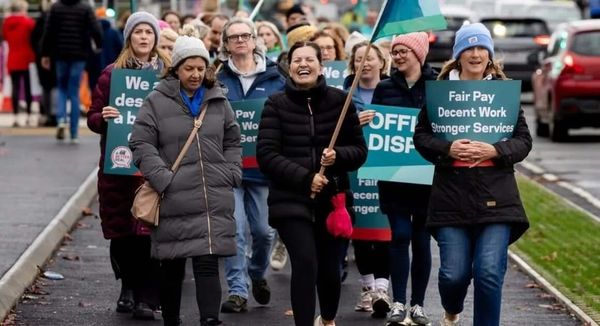
Key to this is street mobilisations. The more people feel their own power, the more they force change on a right-wing government, the more their sights are raised. That was the experience of the water charges movement, Repeal and Marriage Equality.
Here again we can see positive moves. The Irish Neutrality League held a major public meeting, with speakers from Sinn Féin, the Social Democrats, People Before Profit and left independents, to promote a Save Neutrality march on June 14th.
At a recent counter-demonstration against the far right, there were banners from People Before Profit, Sinn Féin, and even the Labour Party. A few months before this, the latter two parties rejected the idea of counter-demonstrations.
On housing, left wing parties have come together to promote a common measure in the Dáil. But they have also agreed under the auspices of Raise the Roof to call for a demonstration at the Dáil to coincide with this. They should also formally back a CATU demonstration in July.
Of course, not all left activists are in favour of this unity. One view is that ‘civil society’ groups can mobilise better than left political parties because many are ‘put off’ by party banners. This is often associated with a belief that parties betray their base and so must be monitored by ‘civil society’.
While this sentiment is understandable given the betrayal of Labour in the recent past and the neoliberal measures of Sinn Féin in the Northern Executive, it is also wrong.
The plain reality is that left political parties have the combined support of nearly 40% of the Irish electorate. If they are willing to work together to achieve it, they can turn this passive voting into active mobilisation. And this is the key to the discussion.
If you believe that change comes from small groups taking direct action, then it is quite possible to ignore political parties.
But if you want to see direct action and mass mobilisation, you can no more ignore left political parties than you can trade unions.
This is not to say that left-wing unity is a good thing in itself. If the purpose is only to create lobby fodder for parliamentary manoeuvres it would be limited, particularly in an era of growing disenchantment with official politics.
But if there is an understanding that mass mobilisation is the key to change, then left unity can be an important step towards this.
And this brings us to the nub of the issue. There are different types of left unity.
One approach might be termed ‘sheltering from the storm’. Here, left-wing activists – usually the more left wing the better – group together to face what they perceive as a hostile world. There is no limit to their demands because it is assumed that only the committed will act. This approach only aims at developing a like-minded community.
Another approach is to subordinate everything to a future electoral project. Thus, it might be suggested that the left should offer a common platform in preparation for a government. But while there are some key issues which all left parties might agree on – saving Irish neutrality, for example – there are major differences over what exactly should be done about the power of capital. Do you just form a government like Syriza did in Greece and wait to be subjected to economic terrorism? Or do you prepare for real working class mobilisations to face these down threats?
A third approach is favoured by socialists. Namely, that left unity is geared to action. We can agree on specific points on where to mobilise working people and thereafter we can argue for our own distinctive policies. We do not have to suppress discussions or claim that because one party works with another, there is guilt by association.
For example, People Before Profit works with other parties in campaigns to defend neutrality. We, like these parties, want to defend the triple lock. However, we also oppose increases in military spending as this is part of the drive towards inter-imperialist war. Similarly, with regard to the Palestine movement, People Before Profit builds alongside others who want the implementation of the Occupied Territories Bill and support a two-state solution, but believe we must go much further and implement comprehensive sanctions and isolation the entire state of Israel so that it can be dismantled in favour of a democratic, single state of Palestine. When it comes to housing, large numbers of people look to Sinn Féin and the likes of Eoin Ó Broin for answers as the main opposition to Fianna Fáil and Fine Gael. If we can mobilise alongside those people, we can build a much larger housing movement, and within that, push back against the concessions Sinn Féin have made on immigration in the face of a rising far right.
The freedom the third option gives is important because there are differences between left parties. People Before Profit will not line up with EU militarism to offer a supposed alternative to Trump; we oppose property taxes unlike others; and crucially we think capitalism cannot be reformed but must be overthrown.
Left unity, however, means that these issues are better addressed by a risen people rather than through small debates that involve few. That would be a big step forward.