Macklemore and the Politics of Celebrity Resistance
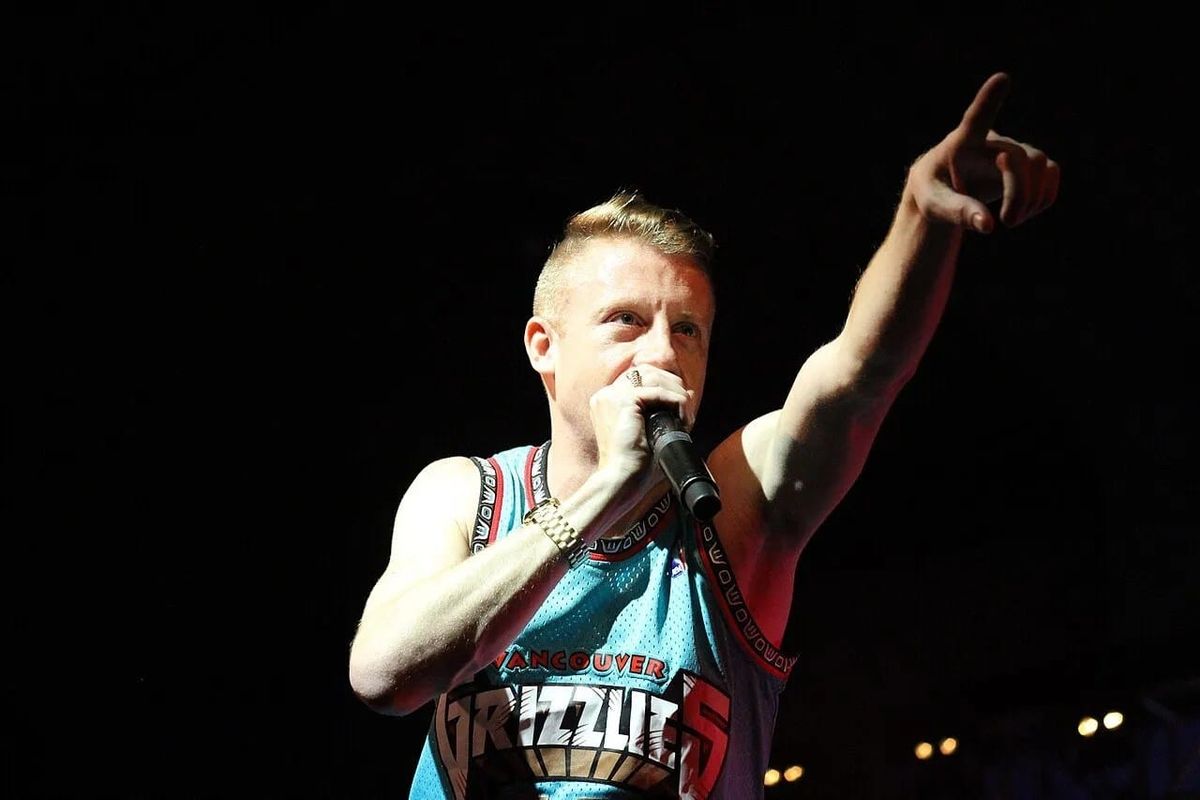
American rapper Macklemore played the first of his Free Palestine Tour performances at a sold out 3Arena in Dublin on the October bank holiday. The high-profile fundraising concert was punctuated by performances from Kneecap, Palestinian singer and TV talent show winner Lina Makoul, DJ Habibeatz, and Dead Prez.
It also included a performance by Hozier, who used his time on stage to demand that the Irish government grant students from Gaza the visas that they have been refused this year. The audience were also treated to a video performance of a children’s choir in Gaza and video messages from Mark Ruffalo, Cynthia Nixon, and the Strokes lead singer Julian Casablancas.
As part of the overall fundraising strategy, Palestine-themed music merchandise was present alongside representation from NGOs such as UNRWA.
Macklemore has been releasing music independently for over 25 years and achieved commercial success in the 2010s. Though hardly a household name, he was known among his fans for using his music to raise consciousness about the effects of addiction, poverty, and other social justice issues.
His reach started to widen when he released Hind’s Hall in 2024, in support of the Gaza solidarity encampments on university campuses. The song and its video is overtly critical of US funding and military support for the genocide in Gaza.
He followed this release with Hind’s Hall 2 (feat. Anees, MC Abdul, and Amer Zahr) and Fucked Up in 2025.
Free Palestine
In September this year, the rapper became a viral media phenomenon for uttering the words “Free Palestine” to an audience of ninety thousand as the support act to pop celebrity Ed Sheeran. Gillette Stadium owner Robert Kraft reacted by pressuring Sheeran to drop him from the remainder of the US tour.
When Sheeran acquiesced, all other musicians involved with his tour pulled out in solidarity with Macklemore and publicly asserted their support for Palestine. These included Irish singer Aaron Rowe, Irish band Beoga, Danish pop band Lukas Graham, and US musician and producer Finneas.
Ed Sheeran left many of his fans disappointed as he floundered in “both sides” equivocations and he rapidly lost hundreds of thousands of Instagram followers. In an attempt to redirect attention back to the genocide in Gaza, Macklemore subsequently announced a fundraiser concert series in Dublin, Paris, and London, all of which sold out.
Macklemore is one of a long line of musicians who have made their support of Palestine public, with Irish musicians often taking the lead due to the affinity between the two national liberation movements. Two high-profile examples include the late Sinead O’Connor, and more recently, Kneecap.
However, innumerable commentators have argued that the Macklemore-Ed Sheeran phenomenon signals a cultural shift. The gist of the argument is that for as long as Zionism has remained the hegemonic position, powerful figures could never be undermined for their silencing of political support for Palestine.
Yet the public punishment of a musician for stating his opposition to the genocide, amplified by Ed Sheeran’s lack of willingness to risk his tour being cancelled, was the last straw.
It is true that this scenario was significant in a few ways. First, it elicited an unusual scale of outrage.
The backlash was so fierce and so large, that it cost superstar Ed Sheeran not only his backing band and opening musicians, but also his reputation among an increasingly politically conscious youth fan base. Media outlets covered it who had never previously uttered the name “Macklemore,” and who rarely acknowledged popular support for Palestine.
Second, the supporting musicians exerted a small-scale but nevertheless successful act of solidaristic labour power by pulling out of Sheeran’s show altogether. Third, Kraft is not only an open Zionist, but a capitalist billionaire who brazenly wielded his power to repress the political expression of a musician performing in his venue.
Such a move is a variation on a theme that is all too familiar for those who have been vocal in their support of Palestine. Finally, Macklemore became more popular as a consequence of standing up to Kraft, which is a morale booster for the movement.
In short, famous people can do good. When individuals or small groups who are well-known to millions of people illustrate courage in the face of capitalist bullies, it can be impressive and inspiring.
In the best case, their actions can propel others to take similar actions.
Celebrities
However, the starting point for most ordinary workers is neither fame nor economic security. When a school teacher is suspended for talking about Palestine in the classroom or a nurse is admonished for wearing a watermelon pin on a shift, the effects of retribution are qualitatively different.
In the best cases, workers are supported by their unions in standing up to their bosses. In the worst, they can experience serious reputational damage and long-term loss of livelihood.
There is no question that it is right to stand up for people who have put themselves on the line. But it is not a political strategy.
For the Macklemore-Ed Sheeran phenomenon not to remain an anomaly and to mark a genuine shift, incidents of this scale have to recur across industries, many times over. Whole football teams across the world need to refuse to play the Israeli state’s team, ideally with the support of their clubs, rather than being pressured to play as the Irish team was this month.
Most importantly, such acts must be bolstered by mass organising. In capitalist culture, fame and celebrity can overshadow the true power that comes from workers.
When a well-known person such as Macklemore undertakes such an act of political courage, disproportionate attention is placed on him, Ed Sheeran, and the spectacle of reaction by media. Government figures are free to weigh into the commentary and do nothing more.
Instead, it must become politically untenable for governments to continue their support for the genocide, or their imperial interests will continue to reign supreme. There is a decades-old movement of Palestinian liberation to learn from and build on for this purpose.
Mass Movement
The capitalist obsession with individuals in the spotlight is not just true of musicians and actors, but also applies to politicians, and even leaders of progressive social movements. In capitalist accounts of successful social movements, too much stock is placed on singular figures, as if the movement was their creation.
For example, the face of Nelson Mandela is widely recognised as the symbol of the end of apartheid South Africa. He is rightly celebrated for his decades of contributions to the anti-apartheid movement, his political sharpness, and his enormous personal sacrifices.
Yet underlying his contribution was a mass, organised Black working class movement in South Africa bolstered by an international BDS movement. In other words, the work required to overturn the system was undertaken by hundreds, thousands, and millions of people both within and outside of the country.
This is not to paper over some key differences in Palestine. The Israeli state, for example, will not be pushed internally by the Israeli working class to free Palestine.
But if anything, this means that the principles of international movement-building are more critical for the Palestinian case, not less.
The brutality, visibility, and persistence of the genocide in Gaza, the ethnic cleansing in the West Bank, and the apartheid system in the borders of 1948 Palestine have turned the popular tide strongly in favour of Palestinian liberation. The wave of repression from states and capitalist institutions that followed the student encampments around the world illustrated that the ruling classes saw the Palestine movement as a threat.
Their fear is reinforced every time someone is punished in a new way for their expressions of solidarity.
While popular musicians who have the ears of millions of people can be a positive boost to morale in this environment of repression, their actions cannot be a stand-in for workers building, organising, and mobilising in their countries to undermine their states’ support for the genocide. The brutality of the Israeli state along with remilitarisation and escalating inter-imperialist wars will continue until our ruling classes are brought to their knees.
Tami Gadir is the author of Dance Music: A Feminist Account of an Ordinary Culture (2023) and a member of People Before Profit and the Socialist Workers Network in Dublin.
Image: San Francisco Foghorn, Macklemore, via Wikimedia Commons (CC BY 2.0).