Orange Order: The Birth of a Counter-Revolutionary Force
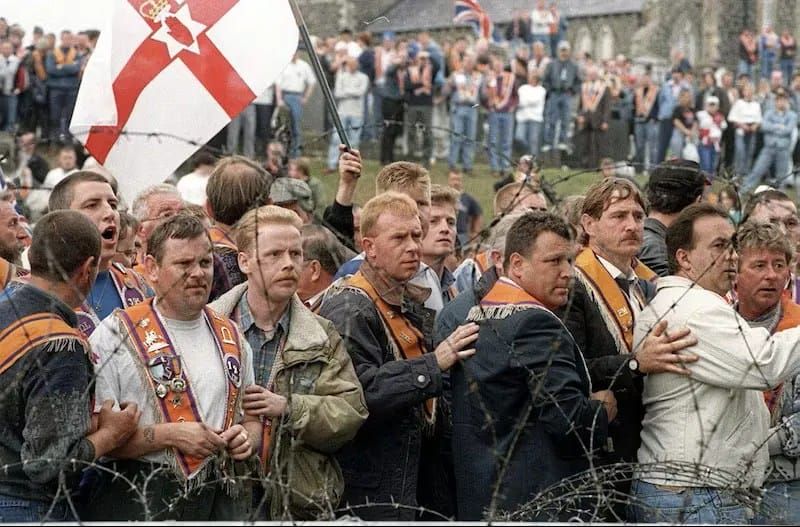
The Orange Order did not start as a gentry project but arose from clashes in Armagh between the mainly Catholic, Defenders, and Protestant Peep o’Day Boys, most famously in the battle of the Diamond in 1795.
Around forty-eight Catholics were shot dead in this skirmish and many were wounded by a better armed Protestant gang which suffered no fatalities.
Such clashes had become more frequent and, undoubtedly, were fuelled by economic anxieties. The fact that Catholics could rent land and draw on linen weaving to supplement their income drove up rents, hitting poorer Protestant tenants more.
Many of the first recruits for the Orange Order, which was formed in Sloan’s Pub in Loughgall, were drawn from this class of people.
Amongst this initial group, however, was Captain John Giffard of the Royal Dublin Militia who had the ear of Edward Cooke, the Under Secretary of Ireland. It was Giffard who drew up the regulations for the new society.
After their successful battle of the Diamond, the Orangemen began a campaign of ethnic cleansing of Catholics from Armagh. About 4,000 Catholics were expelled from the county and many made their way to Mayo, where they helped establish a linen industry.
Despite later claims that they had left voluntarily, organised terror was deployed. Here is one description of what occurred
“Their cabins were placarded, or it was termed papered, with the words “the Hell or to Connaught” and if the occupants did not at once abandon them, they were attacked at night by an armed mob. The webs and looms of Catholic weavers were cut and destroyed. Every article of furniture was shattered and burnt. The houses were often set on fire and the inmates driven homeless into the world. The rioters met with scarcely any resistance or disturbance; twelve or fourteen houses were sometimes wrecked in a single night.
Workplaces employing Catholics were also targeted. Holt Waring wrote a letter to his father about the events in County Down describing how ‘the Magill mill at Tullycairn was burnt last week and a great deal of meal and corn consumed because he would not turn out Popish servants. Fairley’s mill threatened for same reason’.
The Gentry
From the outset there was a tolerance from the local gentry for these Orange atrocities even if they did not give active support.
One reason for the liberal concern was that the expulsion of thousands of Catholics meant a loss of their tenantry for landlords and a probable decline in rents.
Moreover, the emphasis on the ‘rule of law’ meant that the ‘mob’ could not be seen to take measures into their own hands as the British state had long perfected the arrangement whereby administration of justice lay in the hands of the elite. The elite wrote the laws and wanted their implementation to lie solely in their hands -hence their initial disdain of the Orangemen.
On the other hand, the gentry hated the seditious activity of the United Irishmen and were glad to see the new energy among these loyalists even if they did not, yet, publicly approve of their methods.
As the threat of rebellion grew, however, so too did the relationship between the gentry and the Orange Order. It may have begun as a plebeian network but the elite came to see its use as counter-revolutionary force.
They joined their local lodges with Thomas Knox, otherwise known as Viscount Northland of Dungannon, was among the first to get involved but he was not alone.
William Blacker of Carrickblacker helped to form a lodge in Trinity College while Thomas Verner of Churchill formed a lodge on his own estate. Verner went on to form the lodge in Dublin with 300 members drawn from the more respectable elements of the loyalists.
However, the Orange Order should not be seen in any way as representing Protestant culture or as expression of the wider Protestant community.
As Senior, the main historian of the Orange Order has pointed out there were no dissenting clergyman or prominent Dissenters among early patrons of Orangeism. Instead, the Order drew its spiritual sustenance from clergymen of the Church of Ireland such as Reverend George Maunsell who preached such an inflammatory sermon in Drumcree in 1795 that it led to attacks on Catholics.
As the gentry began to take over the leadership of the Orange Order, they worked hand and glove with the authorities.
A Grand Lodge of Ireland was established in Dublin after a previous meeting of delegates, which included one lieutenant, one major, two captains, two warrant officers and eight sergeants, agreed to this centralised body. A ‘castle clique’ who were close to the Irish junto dominated the Dublin lodge and these had a major influence in the Grand Lodge.
Respectability
To establish new lodges, warrants were issued by the Grand Lodge at the price of one guinea which, as one historian has pointed out, was ‘a cost sufficiently high to discourage riff raff who might discredit new brotherhood. As landlord approval was sought, there was an emphasis on respectability.’
The plebeian origins of the Orange Order and the threat of revolution from the United Irishmen meant that the gentry had to drop their snobbery and start mixing with the poorer loyalists in the local lodge. These in turn were altogether happy that they could mix with the upper class.
One historian summed up the take-over, ‘When the gentry framed the rules of the institution, they ensured that the higher orders would mingle with their humbler brethren by requiring that each member of the elite Grand Lodge would also join a local lodge’.
Once respectability was guaranteed, Dublin Castle and the British government set about integrating them into the state security forces. In October 1796, a yeomanry was established as the British government felt they could not rely on the loyalty of the militia and needed a new auxiliary force.
In British terms, yeomanry often referred to a cavalry unit raised by local property owners but the Irish version also included an infantry to help create a more substantial force. It was a paid force under the command of the local gentry.
The suggestion for such a force came from Thomas Knox MP and aim of his Dungannon plan was to turn the Orange Order into ‘an army with banners’. For their part the Orange Order was more than willing to co-operate, offering to provide the government with tens of thousands of men. By early 1797, 30,000 Orangemen had enlisted in the yeomanry corps.
Knox wrote, ‘As for the Orangemen, we have rather a difficult card to play … we must to a certain degree uphold them, for with all their licentiousness, on them we must rely for the preservation of our lives and properties should critical times occur.’
With the backing of the government, the Orange Order increased dramatically. In July 1796, there were several thousand members but by the following year there were 890 lodges. These lodges were encouraged to join the yeomanry, to put down sedition and before long there was even a surplus of applicants.
Croppie lie down
William Blacker, an early Orangeman who had become a captain in the yeomanry wrote, ‘I have now the very difficult task to perform, that of selecting so many candidates. However, by taking into council of a number of Orange leaders, I decided to select a certain proportion from each lodge (and) the thing … was well managed.
Very quickly the Orange yeomanry gained a reputation for utmost brutality and sectarianism.
Lord Downshire reported that the yeomen in Newry decided as ‘their condition of service is that no papist should be enrolled with them… they are chiefly Orange men, and all agree on not admitting a papist.’ Writing from Keady, a Captain O Beirne noted that ‘Orange boys headed by officers in full yeomanry uniforms (are) committing robberies, murders and shameful outrages and claiming government sanctions.’
Any doubt about the British government’s support for the Orange Order were dispelled by the appearance of General Lake, the Commander in Chief of their army in Ireland on the reviewing stand of the Orange parade in Lurgan on July 12th 1798.
A popular song amongst the Orange paid tribute to their self-declared counter-revolutionary role.
O croppie’s, ye’d better be quiet and still
Ye shan’t have ye’r liberty, do what ye will
As long as salt water is found in the deep
One foot on the neck of the croppy we’ll keep
Down, down, down, croppie’s lie down
Ironically in view of later developments, it was the largely Protestant freeholders of Ballymena who, in a petition, expressed alarm at these developments.
They wrote that government ministers ‘laboured with the most remorseless perseverance to revive those senseless and barbarous religious antipathies so fatal to morals and to peace and so abhorrent to the mild and merciful spirit of the Gospel’.
Opposition to the Orange Order came not only from Catholics but from those Protestants who wanted a free and independent Ireland.