State Still Protects Church Power
In the wake of the Pope’s visit, Kieran Allen asks is the Irish state really prepared to challenge the power of the Catholic Church? Or will it continue to shield it from justice.
On the morning of the papal visit, Leo Varadkar claimed that the majority of people did not want ‘a complete separation of church and state’. The use of the word ‘complete’ was significant because he had previously said that he favours separation. Later in the day he suggested a ‘new convenant’ with the church.
The ambiguity is not accidental. Fine Gael’s embrace of liberalism is a cold calculated move to appeal to a younger generation to outwit their rivals in Fianna Fáil. But it is skin deep and they want to shut down conflicts with the Catholic Church as quickly as possible. Varadkar’s ‘quiet revolution’ is all about limiting a movement to end church control.
This explains why official Ireland embraced the Pope’s visit with such gusto. Although it was not a state visit, all the resources of the state were deployed to hype it up. Roads were closed off all over Dublin. Reports of traffic restriction were broadcast frequently and booklets sent to many houses. RTE reverted to its reverential coverage with a host of priests appearing to explain the pontiff’s inner thoughts. During a papal concert in Croke Park, there was even an ‘Après Match’ type ‘analysis’ of every move. In the end, however, it backfired.
According to RTE and the mainstream press, 500,000 were expected to attend a mass in Phoenix Park. But just 130,000 turned up. That is one tenth of the crowd that attended that last papal mass in 1979—when there was a smaller population.
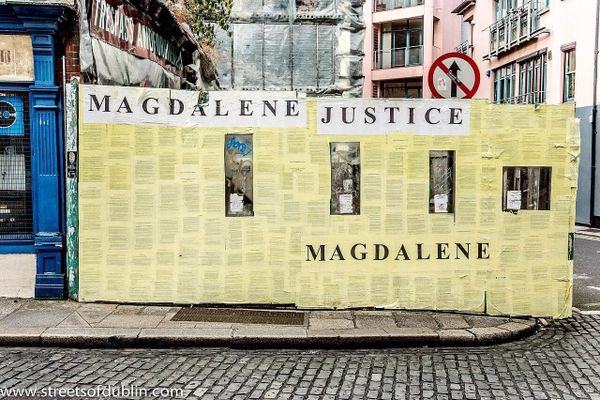
By contrast, thousands gathered for a silent march to the last Magdalene’s home in Dublin’s Sean McDermot Street which only closed in 1996. In Tuam, where 796 babies were buried in a septic tank, over a thousand people gathered to read out their names and demand a full excavation.
The pope’s visit coincided with revelations from a grand jury inquiry in Pennslyvania. This identified 1,000 victims who had been abused. It sparked off memories of what occurred in Ireland and threw a sharp light on the outstanding issues that the state and church thought they had buried.
Let’s look at some of those issues.
Child abuse: A number of clerics have been prosecuted in Ireland. But in contrast to Chile, for example, where the state raided offices of the Catholic Church, the Ryan Commission engaged in a ‘process of consultation with religious congregations…to establish procedures that would enable it to complete its work within a reasonable time’.
As a result, the names of perpetrators were anonymised—unlike the Pennsylvania method. Records were handed back to the Catholic Church and evidence taken by the Commission could not be used in court proceedings. The establishment of ‘Commissions of Inquiry’ has become the principal method by which the Irish state covers up for both clerical and political corruption. It serves two main functions: it helps to diffuse an immediate scandal and hide long term inaction.
Slave Labour: The wealth of the Irish Catholic church has grown due to the forced detention of single mothers and the use of their free labour. This occurred most notably in the Magdalene Laundries—but also in Mother and Babies homes were a class distinction was imposed. Those deemed to be ‘in sin’ and without money had to work for free to cover their time spent in these homes. Nothing has been done to take assets from clerical organisations which benefited. In the case of Bons Secours, for example, they went from burying children in a septic tank in Tuam to opening a number of profitable private hospitals.
The Woods Deal: This deal, which was concluded in 2002, guaranteed state money to indemnify the Catholic Church against litigation on child abuse. The church initially only contributed 128 million euros and the state agreed to pay the rest. It has cost Irish tax payers 1.5 billion euros. Clearly, it should be scrapped and the money should be recouped from church authorities.
Medical Procedures: One month after the vote on Repeal the Irish Bishops issued new ethical guidelines banning abortion, sterilization and gender re-alignment operations in their hospitals. About 20 major hospitals are publicly funded but run on a supposedly voluntary basis by trusts that are under the effective control of the religious. It is time to end this absurdity and put all hospitals under public ownership and control.
Schools: It is unacceptable that the Irish state takes no responsibility for providing primary education. 92% of primary schools are effectively run by Bishops who have no knowledge or experience of child education. To this day, teachers can be sacked—and certainly not recruited—for speaking out against their religious ethos. In secondary schools, teenagers are forced to attend compulsory religion classes or listen to Catholic moralism dressed up as sex education. This is often given by agencies like Accord who fail to adequately address issues of consent, LGBT rights, contraception or abortion.
Charity or Social rights: A culture of charity and voluntary effort needs to be replaced with one of social rights. A recent Benefacts report states that Ireland is ‘ uniquely dependent’ on voluntary charity organisations for social care and health services. There are nearly 9,000 registered charities and the Health Service Executive spends €4 billion a year supporting them.
This culture of reliance on voluntary effort arises from a Catholic principle of ‘subsidiarity’. This sought to limit the provision of public services lest it crowd out the space for charity. In the name of this principle, Irish Bishops opposed a state run health system as ‘totalitarianism’.
But this same principle of denying social rights is also embraced by today’s neoliberals. Varadkar, for example, insists that there is a “valuable role to play for religious bodies of all sorts when it comes to charitable provision, when it comes to welfare.’
There is an ideological project at work here. The political elite want to encourage an attitude of gratitude rather than an assertion of social rights to housing, education or health care.
But the fictional notion that schools, for example, are run on a voluntary basis means that schools in working class areas receive lower levels of funding because local parents cannot contribute as much as those in wealthier areas.
All of this means that a real separation of church and state goes well beyond a liberal agenda of personal choice because it must also embrace equality.