Venezuela: It Was Never Socialist
Sometimes socialists are tempted to see the ‘enemy of my enemy as my friend’. When the corporate media engages in blatant pro-Western propaganda, you want to go to the opposite extreme and support their opponent. When Assad was demonised, you felt it was better to turn a blind eye to his crimes. When Cuba is under attack, you don’t want to be critical of its regime.
It’s a bad strategy – and not just because it leads to self-censorship. You are forced to tell lies to your own working class, implicitly or explicitly. And that has consequences. If you cannot trust working people with the truth, what hope is there of liberation? Moreover, you store up massive disillusionment for yourself.
When the supposed ‘socialist regimes’ are overthrown, you are driven to either conspiracy theories about CIA plots or deep pessimism about the power of working people.
Which is not to say there are no plots. Or that if you live in the Western camp your primary emphasis should be on exposing the lies of imperialism. But you can do this better by being critical, by looking reality in the face.
Venezuela is a case in point.
Kidnap
In January, Trump ordered the kidnapping of its president, Nicolás Maduro, and his wife, Cilia Flores. It was a blatant display of the US’s desire to rule over the continent of Latin America. The excuses were transparent lies. It had nothing to do with promoting ‘freedom’.
If that were the case, the first to be kidnapped by the US would be the Saudi Arabian President Mohammed bin Salman, who organised the murder of the journalist Khashoggi. Nor should we give any credence to claims about drug running. Trump has used these charges against countries as diverse as Canada or China.
In the aftermath of this kidnapping, Trump has allied with Maduro’s deputy, Delcy Rodriguez, to take control of Venezuela’s oil. He claims to have the ‘BIGGEST OIL DEAL IN WORLD HISTORY’. He promises, and we can discount the bluster, that it will give America ‘energy dominance’.
Essentially, the US, via the US Department of Defense’s Office of Strategic Capital (OSC) has been given a 35% stake in North American Blue Energy Partners. This is a private oil company, the second-largest in Venezuela, which will now be controlled by US citizens.
It owns concessions to 17 oil fields, containing 65 billion barrels, or about one-fifth of the country’s oil. For the next century, the US will be able to buy oil at cost price and not pay taxes to the Venezuelan regime.
Even before this deal, Venezuela reformed the General Hydrocarbons Law and granted permission to US and foreign oil companies – excluding any from China, Russia, Iran or North Korea – to participate in Venezuela’s vast oil wealth. One of the main beneficiaries is Chevron.
Resource Nationalism
This is a move away from ‘resource nationalism’. This was a trend whereby local states, including even Saudi Arabia, took control of their natural resources from foreign multinationals. Venezuela has now returned to what can only be described as a form of neocolonialism. No wonder that left-wing protesters marched through Caracas with banners reading: “We are neither a colony, nor a backyard” and “Yankees go home!”
But the question for socialists is: How could this occur by the kidnapping of just one man and his wife? How could you go from leftism to neo-colonialism in a few months, without any mass upheaval or revolts?
Here, contrary to the myth propagated in the right-wing press, it is necessary to tell the truth: Venezuela was never socialist. The narrative that ‘socialism led to inefficiency’ and had to be rescued by Trump’s America is pure nonsense.
To understand what happened, we need to return to 2002, when the right wing staged a coup against President Hugo Chavez and briefly put into power a business leader, Pedro Carmona. Chavez was a left-wing military officer who won an election based on policies that promised real national development.
Originally, he was not particularly in favour of a ‘socialism from below’, but the failed coup radicalised him. After all, he was rescued from imprisonment by an uprising of the poor of Caracas. This in turn helped to unleash a wider revolutionary dynamic against the Venezuelan elite.
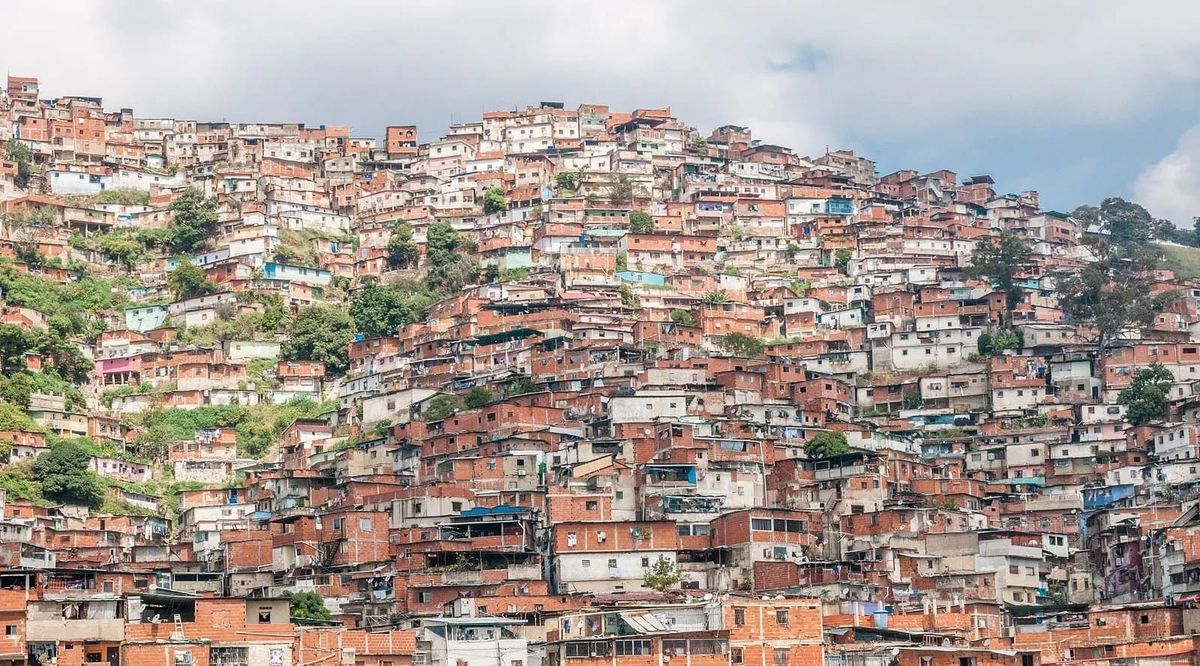
Afterwards Chavez began to talk of building ‘21st century socialism’. This, in contrast to the USSR model, was to be democratic and to be based on grassroots participation. He used funds from the publicly owned oil companies to distribute money to the poor. These were organised through ‘Bolivarian Missions’ (named after the liberator, Simon Bolivar), and these brought extra resources for education, health and cultural activities to the barrios.
Redistribution
However, Chavez himself recognised that this was a form of redistribution – rather than socialism. Just before he died, he wrote:
‘We shouldn’t let ourselves be deceived: the social and economic system that still prevails in Venezuela is a capitalist and rentier system. In order to move towards socialism, we need a people’s power capable of disarticulating the oppression, exploitation and domination plots that still exist in the Venezuelan society.
People’s power should be able to shape up new social relations in our everyday life, where fraternity and solidarity go hand in hand with the continued emergence of new forms of planning and production of material wealth for our people.
To achieve that, it is necessary to completely pulverise the bourgeois state that we have inherited, which is still being replicated through its old and nefarious practices, and ensure continuity in the process of creation of new forms of policy management.’
Chavez was correct: socialism implies more than re-distribution – it means the taking of control of factories, offices and the wider economy by working people. It cannot be handed down by military officers or a guerrilla leader, no matter how left-wing they sound, but must be built by the mass of people themselves. It is to Chavez’s credit that he partially recognised this.
The Bolivarian revolution did not uproot the power of the rich clans – the Capriles, Cohen, Otero Silva, Baute – who dominated its society. In particular, private interests were able to keep control of the importation of food. They could get hold of dollars at very cheap rates – and then make huge profits on the sale of food in the local currency inside Venezuela.
Within a deeply corrupt state, a Chavista bureaucracy emerged to thwart popular will. This became obvious when peasants tried to seize land or when workers wanted to take control of their factories. The state bureaucracy, including elements which pretended to support Chavez, stopped them.
On top of these problems, the US began to impose sanctions on Venezuela, which Trump then intensified when he first took office. To go forward, Venezuela needed to deepen the revolution – and seek to spread it to other Latin American countries.
Maduro’s strategy
Chavez’s successor, Maduro, did the opposite, trying to appease the rich and the military generals, even when they despised him. One example suffices to show the direction.
In August 2016, the Venezuelan government announced that multinationals such as the Barrick Gold Corporation could invest in a controversial Orinoco Mining Arc. The area contains 112,000 square kilometres, and the deal allowed them to extract massive reserves of gold, copper, coltan, and diamonds. This was despite protests from environmental groups who opposed deforestation and the expansion of illegal mining networks in the Amazon basin.
No doubt Maduro faced terrible sanctions from the US and a vicious right-wing opposition at home. He was unfortunate to rule during a decline in oil prices. But instead of relying on workers’ power and trying to spread the resistance beyond his country’s borders, he did the opposite.
He attacked union rights, privatised sugar mills, agricultural distribution centres, and coffee producers, and devalued the currency to push up prices for working people. He held onto power only by increasing repression.
None of this, of course, gives the US the right to kidnap him.
The Venezuela experience contains important lessons for socialists all over the world. First, we can never underestimate the determination, brutality and sabotage that the rich will engage in to stop any attempt – no matter how mild – to tamper with their privileges. When they have no success in their own countries, they will call in their Big Brother in the White House.
Second, defeating them means continuing and deepening a revolutionary process. Rather than halting at expressions of loyalty to a left-wing hero, working people must take matters into their own hands. Never again must banks, food importers or key industries be left in the hands of the rich.
Kieran Allen has written Marx and the Alternative to Capitalism to argue for a socialism from below.